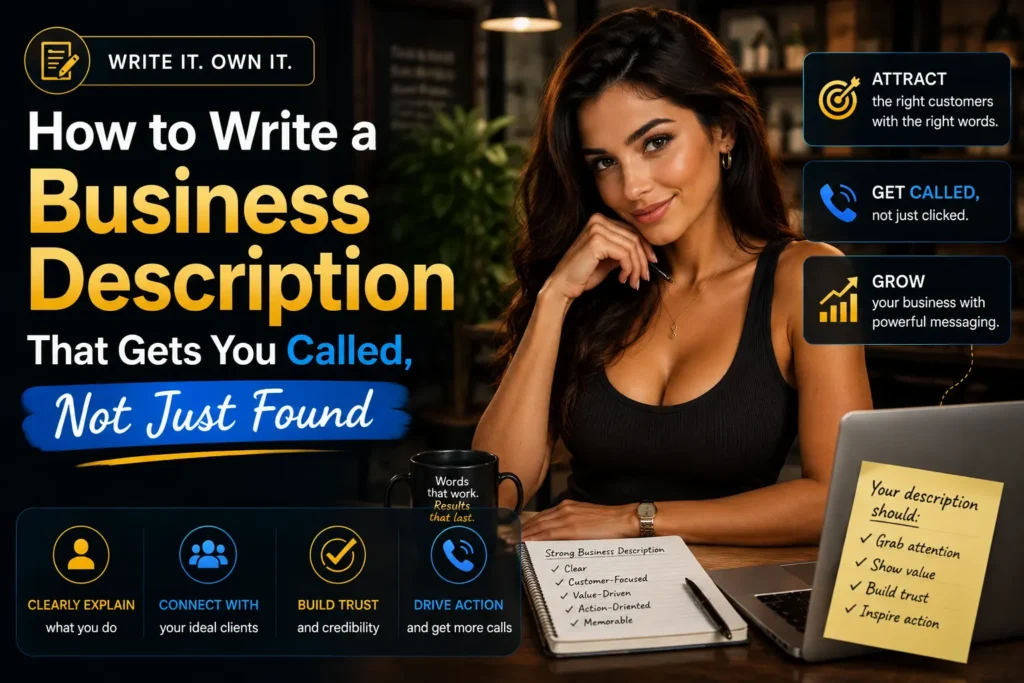
How to Write a Business Description That Gets You Called, Not Just Found
There’s a moment that decides whether you get the call, and it lasts about three seconds.
Someone has searched for what you sell. They’ve got six results in front of them. They’re not reading carefully — they’re scanning, and they’re looking for a reason to eliminate you so the list gets shorter. Your description is what they land on.
Most business descriptions fail that moment badly. Not because they’re poorly written, but because they were written for the wrong reader. They were written for a search engine.
The two jobs, and the one everyone forgets
A description has to do two things.
The first is get you found. This is the part everyone knows about. It’s why descriptions end up stuffed with phrases like “affordable plumbing services in Riyadh” repeated four different ways.
The second is get you chosen. Being found puts you on the list. Being chosen is what produces the phone call. And these two jobs pull in genuinely different directions, because the words that satisfy a search algorithm are rarely the words that reassure a nervous human with a burst pipe.
Owners over-invest in the first job because it feels measurable. You can see your ranking. You cannot see the twelve people who found you this week, read your description, and quietly picked someone else.
That invisible loss is the expensive one.
The first line has one job
Whatever else your description does, the opening line has to let the reader confirm one thing: this business does the specific thing I need, near me.
That’s it. Not your values. Not your founding year. Not your commitment to excellence.
Here’s what most first lines look like:
“Welcome to Al-Noor Services! We are a leading provider of quality solutions committed to customer satisfaction and excellence in everything we do.”
Read that as a customer with a broken air conditioner. What have you learned? That the business exists. That’s all. Nothing in that sentence tells you whether they can help you today.
Now:
“We repair and install split and central air conditioning units across north Riyadh, usually within 24 hours of your call.”
Same business. But the second version answers what, where, and how fast before the reader has to work for it. If that’s what they need, they’ve already decided. If it isn’t, they leave immediately — which is also a win, because you didn’t waste a call on it.
Specificity beats adjectives, every time
The single most common weakness in business descriptions is adjectives standing in for facts.
“Professional.” “Reliable.” “High-quality.” “Trusted.” “Affordable.”
Every competitor uses these words. They’re free to claim, which means they carry no information. When every option on the page says “reliable,” the word stops meaning anything at all.
Facts can’t be copied so easily. Compare:
“We offer affordable, high-quality catering for all occasions with professional service you can trust.”
against:
“We cater weddings and corporate events from 40 to 400 guests, with Lebanese and Saudi menus. Fixed per-head pricing, no service charge, and we handle setup and cleanup.”
The second doesn’t use a single adjective about itself. It doesn’t need to — the specifics do the persuading. And “40 to 400 guests” quietly does something clever: it disqualifies the person planning a dinner for eight, saving both of you a wasted conversation.
A useful test: go through your description and ask of each claim, could my worst competitor write this exact sentence? If yes, cut it or replace it with something only you can say.
Where keywords belong
You do still need the words people search for. The question is placement.
Put your core service phrase in the first sentence, where it reads naturally. Say it once more somewhere in the body if it fits without strain. Then stop.
Natural:
“We’re an independent car rental company in Jeddah, offering economy and SUV rentals with delivery to King Abdulaziz airport.”
Strained:
“Looking for car rental Jeddah? Our car rental Jeddah services offer the best car rental in Jeddah for all your Jeddah car rental needs.”
The second one doesn’t just fail with human readers — search engines have been discounting that pattern for over a decade. It’s the rare mistake that loses on both fronts at once.
Write the sentence you’d say out loud to a customer standing in front of you. If it sounds strange spoken, it reads strange too.
Handle the three things people are actually wondering
Most readers have the same three unspoken questions, and most descriptions answer none of them.
What does it cost? You don’t need a full price list — you need to prevent the fear of an unpredictable bill. A range works. So does structure: “fixed per-job pricing quoted before we start,” or “consultations are free, treatment plans priced individually.” Silence on price makes people assume expensive.
Do you cover me? Name your actual area. Districts and neighbourhoods, not just the city. Someone in a specific district wants to see their district.
When can you help? Same-day, next-day, by appointment, weekends. Especially for urgent trades, this is often the deciding factor and it’s usually missing entirely.
Three rewrites
A plumber.
Before: “Expert plumbing services with years of experience. We handle all types of plumbing work at competitive prices. Customer satisfaction is our top priority.”
After: “Emergency and general plumbing across east Riyadh — leaks, blocked drains, water heater repair and bathroom installation. We answer calls until 10pm and can usually be there the same day. Call-out fee quoted upfront, no surprises on the invoice.”
A salon.
Before: “A luxury beauty salon offering premium services in a relaxing environment. Our professional team is dedicated to making you look and feel your best.”
After: “A women-only salon in Al Olaya specialising in colour, balayage and keratin treatment. Our colourists trained in Beirut and we use Olaplex and Kérastase. Walk-ins welcome for cuts; colour appointments book about a week ahead.”
An IT services company.
Before: “We provide innovative IT solutions and cutting-edge technology services to help businesses achieve their digital transformation goals.”
After: “We handle IT for small businesses in Riyadh with 5 to 50 staff — network setup, Microsoft 365 migration, and ongoing support on a monthly retainer. Most clients are clinics, law firms and accounting practices. Response within four working hours, guaranteed in writing.”
Notice what changes in all three. The adjectives disappear. Numbers appear. The reader can tell within one line whether this business is for them.
A structure you can fill in
Four sentences will beat almost everything on the page:
- What you do, where. The specific service, the specific area.
- What exactly is included. Two to four named services — the real ones, not categories.
- What makes you the choice. One concrete differentiator: a qualification, a guarantee, an area of focus, a piece of equipment, how long you’ve operated. One. Chosen honestly.
- What happens next. Price structure, availability, and how to reach you.
That’s 60 to 100 words and it will outperform 300 words of adjectives.
If your platform gives you more room, add a short second paragraph about who you typically work with. “Most of our clients are…” is disarmingly effective, because it lets the reader place themselves — or rule themselves out — without you having to ask.