Fake Reviews: How Customers Spot Them, and Why They Cost More Than They Earn
Start with the finding that makes the rest of this article unnecessary for most people.
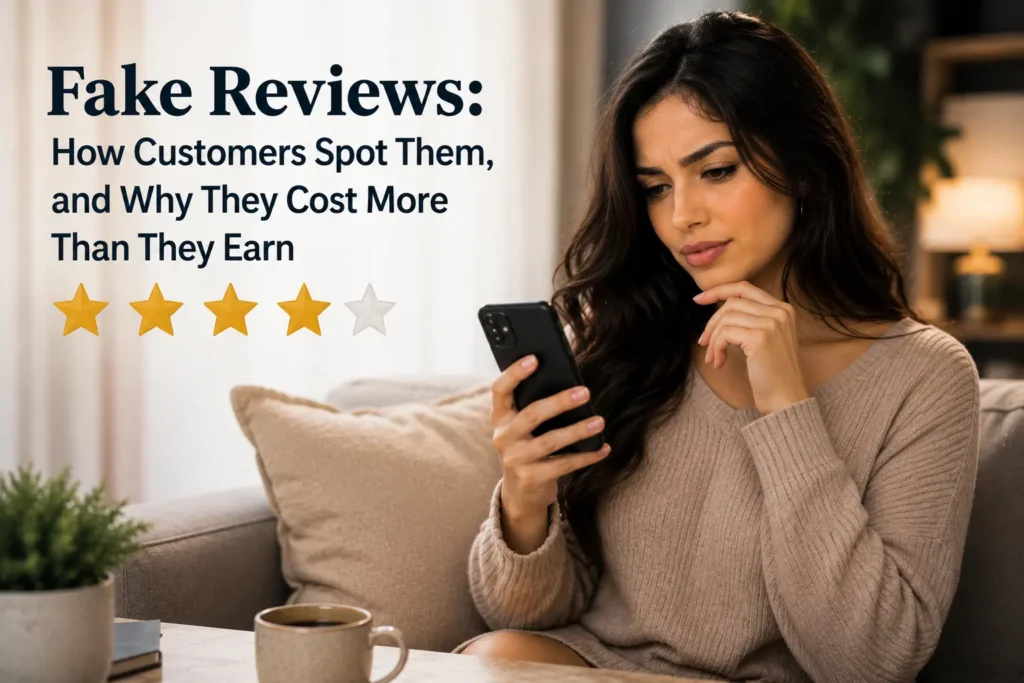
A perfect five-star rating converts worse than a slightly imperfect one.
Not marginally worse in some edge case — reliably worse, and it’s been observed repeatedly across large volumes of purchasing behaviour. Ratings somewhere in the mid-to-high four range consistently outperform a flawless five.
If you’ve been tempted to buy reviews, that’s the whole argument. The thing you’d be paying for is worth less than what you already have.
Why flawless reads as false
The mechanism is straightforward once you see it.
Perfection is implausible, and people know it. Everyone has had a decent experience with a slightly grumpy staff member, a longer wait than expected, a small thing that went wrong. A business with a hundred reviews and not one person who noticed anything imperfect contradicts everyone’s lived experience.
Imperfection is evidence the reviews are real. A mix of ratings suggests nobody filtered them. That makes the positive ones credible, because they clearly weren’t curated.
Negative reviews are informative. Shoppers actively seek them out — not to be put off, but to find out what the worst case looks like. A one-star review complaining about parking tells a reader the actual service was fine. That’s more reassuring than a hundred unspecific raves.
Handled complaints demonstrate character. A calm, specific reply to a harsh review shows what happens when something goes wrong. Nothing on a flawless profile conveys that.
So the practical target isn’t perfection. It’s a strong average with visible imperfection and visible responses.
How ordinary customers spot fakes
Not experts — ordinary people, and mostly without conscious effort. The tells:
Timing clusters. Fourteen reviews in three days after eleven months of nothing. This is the most recognisable pattern of all, and it’s exactly what buying produces.
Uniform enthusiasm. Every review five stars, similar length, similar vocabulary, no specifics. Real reviews vary wildly in length and mention odd particulars — the parking, a specific staff member’s name, the weather.
Generic praise. “Great service, highly recommended, will use again.” Real reviews describe things. Fake ones describe feelings.
Reviewer profiles with no history. One review ever, no photo, an odd name. Anyone can click through and see this.
Service-language mismatch. Reviews for a local plumber written in polished marketing English about “exceptional customer journey.”
Nothing in between. All fives and a couple of ones, nothing in the middle. Real distributions have threes and fours.
Repeated phrasing. The same distinctive phrase across several reviews — a giveaway that one person wrote them all.
You’ve probably applied several of these while shopping without ever naming them. So have your customers.
What the platforms detect
Separately from human readers, platforms run detection at scale, and it’s better than owners assume.
They look at review velocity against your history, whether reviewers have plausible activity patterns, device and location signals, whether accounts reviewing you also cluster around other businesses, and linguistic similarity across reviews.
Consequences range from silently removing the reviews — you paid and received nothing — to warnings, to profile suspension. Suspension is the serious one: you disappear from search entirely while appealing, and appeals take weeks.
In a growing number of countries, buying or selling fake reviews is also unlawful under consumer protection or unfair trading rules, with genuine financial penalties. The regulatory direction has been one way for several years.
Review gating: the version people don’t realise is prohibited
There’s a subtler practice that many owners have been sold as best practice.
You send customers to a private feedback form first. Happy ones get directed to leave a public review; unhappy ones get routed into a private complaints channel.
This feels responsible. It’s prohibited on every major platform, and it produces exactly the suspicious flawless profile discussed above.
The legitimate version: ask everyone, the same way, at the same point. Some will be unhappy, and their reviews are useful — both as feedback and as evidence to readers that your profile isn’t filtered.
When a competitor is buying reviews
Frustrating, and worth handling carefully.
Report them, without expecting much. Use the platform’s reporting tool. Decisions are largely automated and most reports don’t produce visible action. Report anyway; patterns accumulate.
Never mention it publicly. Not in your own listing, not in review replies, not on social media. Publicly accusing a competitor makes you look bitter and invites scrutiny of your own profile.
Never retaliate. Leaving fake negative reviews on a competitor is the same offence, and it’s easier to trace than people think.
Compete on the thing they can’t fake. Their reviews are generic because they’re invented. Yours can name specifics, describe real situations, and sit alongside your visible replies. Over a year that’s a stronger asset than their number.
The uncomfortable truth: they may benefit in the short term. Bought reviews sometimes work for a while. They also carry a permanent liability — a suspension or a regulatory action arriving at an unpredictable moment. Businesses that build slowly aren’t carrying that.
What to do instead
Ask everyone, consistently. Build it into the end of every job. Consistency beats intensity.
Ask at the right moment. Right after the customer has expressed satisfaction, not days later.
Make it one tap. A direct link, a QR code, a saved message template.
Reply to everything, including the bad ones. Your replies are read by far more people than the reviews themselves.
Accept the imperfect average. A 4.6 with visible responses outperforms a 5.0 nobody believes.
The short version
Perfect ratings convert worse than imperfect ones, so the thing fake reviews buy is worth less than what you have.
Ordinary customers spot fakes routinely: clustered timing, uniform enthusiasm, generic praise, empty reviewer profiles. Platforms detect them too, and in a growing number of places it’s unlawful.
Review gating — filtering unhappy customers away from the public form — is prohibited even though it’s widely sold as good practice.
The slow approach compounds, and it doesn’t carry a liability that surfaces at the worst possible time.