Hours, Service Areas and Holidays: The Trust Signals Customers Check Before Calling
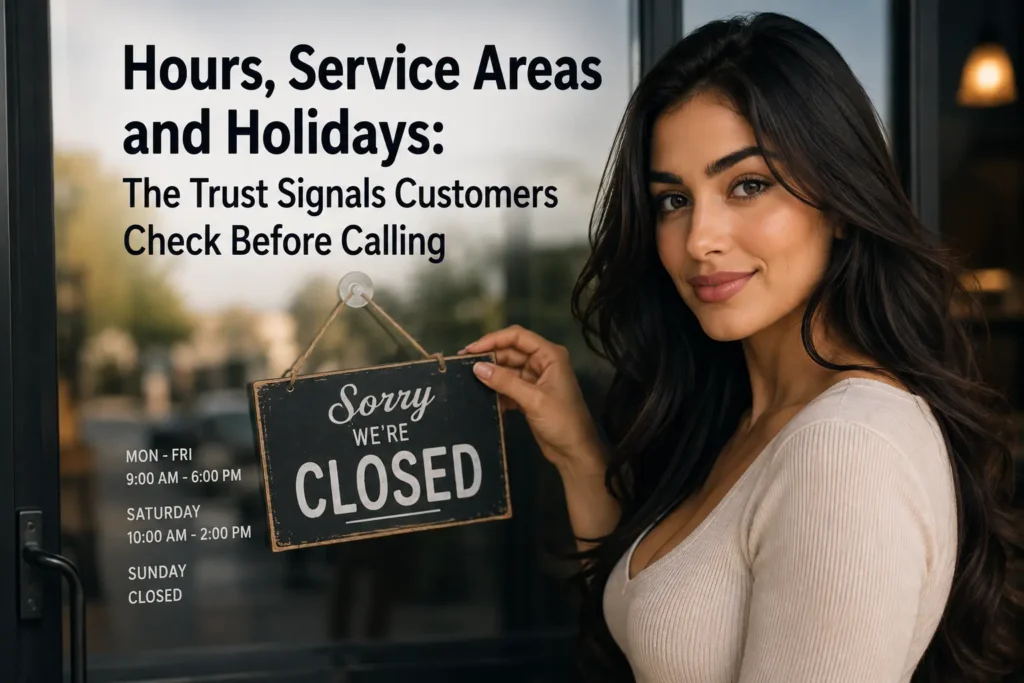
There’s a small moment right before someone contacts you. They’ve found you, they’re fairly convinced, and then a doubt surfaces:
Are they even open? Do they come out to where I am? Is it worth the call?
That moment is where a lot of business is quietly lost. Not because the answer was no, but because the listing didn’t answer at all, and the person moved to the one that did.
Wrong hours is worse than no hours
Blank hours cost you the customer who wanted certainty. Wrong hours cost you the customer permanently.
Think about what actually happens when someone travels to a business that your listing said was open and finds it closed. They’ve wasted a journey. They’re annoyed. And the annoyance attaches to your name specifically — not to a category, to you. That person doesn’t come back, and they may well tell someone.
This is why the routine “we’ll fix the hours later” is more expensive than owners assume. An empty field is ambiguity. A wrong field is a broken promise.
Fill in every day, including the closed ones
“Closed Sunday” is information. A blank Sunday is a question.
The same applies to unusual patterns — a long lunch closure, different Saturday hours, evenings by appointment only. Whatever’s true, say it. Customers don’t mind constraints; they mind not knowing.
A related trap: if you genuinely operate by appointment rather than fixed hours, most platforms have a way to express that. Use it rather than inventing hours you don’t really keep, because invented hours become the wrong-hours problem in a week.
The “open now” filter you can’t see
This one is invisible and it costs more than it should.
Many searches filter for businesses currently open, and on some platforms this happens by default in certain contexts. If your hours are missing, you may be excluded from those results entirely — not ranked lower, excluded.
You’ll never see this happening. Your listing looks fine. There’s no report showing the searches you were removed from. It’s the clearest example of an empty field costing you visibility rather than just persuasion.
Holiday and seasonal hours: the field nobody updates
This is the most neglected item in this entire article, and the one with the sharpest cost.
Every platform lets you set exceptions for specific dates. Almost nobody uses it. So on the days when people are most uncertain about whether anything is open — public holidays, religious festivals, the end of the year — listings everywhere confidently display normal hours that are simply wrong.
Two things make this worse than ordinary wrong hours. Demand is often unusual on those days, and doubt is high, so the business that has clearly stated its holiday hours stands out enormously against competitors showing defaults.
Practical approach: once a year, sit down with a calendar and enter every exception you can anticipate. Public holidays, religious observances, your annual closure, reduced periods. Twenty minutes, once, and it covers twelve months.
If your region has a season where hours shift substantially — a religious month with different trading patterns, a summer slowdown, a tourist season — set those exceptions in advance too. This varies enormously by country, which is exactly why the platform defaults can’t help you and manual entry is the only option.
Service area versus address
The second doubt: do you cover where I am?
The setup depends on what kind of business you are, and getting it wrong produces confusing symptoms.
If customers come to you — a shop, a clinic, a restaurant — show your address. Make sure the map pin sits at the entrance customers actually use, not the centre of the building or the far side of a car park.
If you travel to customers — trades, mobile services, consultants who visit clients — hide your address and define service areas instead. A home address published on a listing anchors you to a residential area and tells customers something you may not want to share.
If both — a workshop customers can visit, plus call-outs — show the address and define the service area as well.
Name areas the way customers do
Define your coverage in the words people use for where they live. Districts, neighbourhoods, suburbs, towns. Not administrative regions, not postal code ranges, not “within 30km.”
Someone in a specific district is looking for that district’s name. If your listing says only the city, they can’t tell whether you mean them.
The thing that surprises everyone
Setting a large service area does not make you rank across it.
Proximity still applies from your registered address. A plumber covering an entire metropolitan area will realistically only appear in results reasonably near their base, regardless of what the service area says.
Service area tells customers where you’ll work. It doesn’t extend your reach. Owners set it wide expecting more visibility, see no change, and conclude the platform is broken.
Contact options: the third doubt
Is it worth the call?
A significant number of people will not telephone a business. They’re at work, in a shared space, uncertain what to say, or more comfortable writing than speaking — especially in a second language.
If a phone number is your only contact method, you lose all of them silently.
Add an email address, a messaging option, or a contact form. Then monitor it. A listed channel nobody checks is worse than not listing it, because now you’ve failed someone who did reach out.
A maintenance routine that takes ten minutes
The reason this information goes stale isn’t laziness — it’s that nothing prompts you. Set your own prompt.
Every three months, check:
- Are the regular hours still accurate?
- Have any contact details changed?
- Is the service area still right?
- Are you monitoring every contact channel you’ve listed?
Once a year, in January:
- Enter every holiday and seasonal exception you can anticipate for the coming year
Immediately, whenever:
- You change hours, even temporarily
- You move, or change what area you cover
- You change a phone number or email address
Put the quarterly check in your calendar now. It’s the only reliable way this gets done.
The short version
Fill in every day, including closed ones. Set holiday exceptions a year ahead — almost nobody does, and it’s the easiest way to look more reliable than your competitors. Show your address if customers come to you, hide it and define areas if you go to them. Name areas the way customers name them. Don’t expect a wide service area to widen your ranking. Offer a contact method that isn’t a phone call.
None of it is interesting. All of it is checked in the seconds before someone decides.