How Local Search Really Works: Proximity, Relevance and Prominence in Plain English
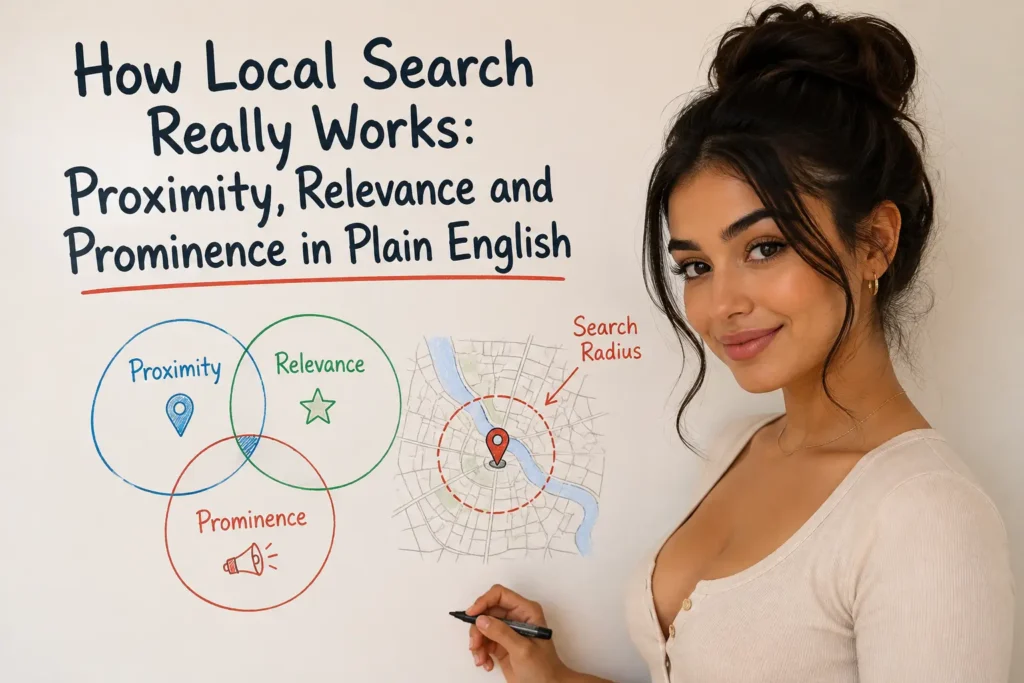
Most advice about local search skips the part that would make the rest make sense.
Owners get told to add photos, collect reviews, fill in categories — a list of tasks with no explanation of what any of them are doing. So the tasks feel arbitrary, get done half-heartedly, and when results don’t come there’s no way to work out what went wrong.
Underneath all of it are three factors. Once you know what they are, most of the advice becomes obvious, and — more usefully — you can tell which advice doesn’t apply to you.
The three factors
When someone searches for a business near them, the results are decided by three things working together:
Proximity — how close you are to the person searching. Relevance — how well you match what they asked for. Prominence — how well-known and well-regarded your business appears to be.
They aren’t weighted equally, and the weighting shifts depending on what’s being searched. A search for “coffee” leans heavily on proximity. A search for “employment solicitor specialising in tribunals” leans heavily on relevance and prominence, because people will travel for that.
That shift is the single most useful thing to understand, and we’ll come back to it.
Proximity: the one you can’t fix
Proximity is straightforward and slightly brutal. The closer you are to the searcher, the more likely you appear.
There’s no setting for this. You can’t buy your way around it. You cannot rank in a district you’re not near, no matter how complete your profile is or how many reviews you’ve collected.
This is where most of the frustration in local search comes from, and it produces two specific misunderstandings.
“I set my service area to the whole city, so why don’t I appear across it?” Because service area tells Google where you’re willing to work. It doesn’t change where you rank. Proximity still applies from your registered address. Setting a wider area doesn’t extend your reach; it just tells customers you’ll travel.
“My competitor ranks in three neighbourhoods and I rank in one.” Usually because they have three locations, or their single location sits between areas while yours sits at the edge of one.
The practical consequence: stop measuring your ranking from your own office. Your results there will always look better than reality. Check from where your customers actually are, or you’ll congratulate yourself on a position nobody else sees.
What you can do about proximity: not much directly. Which is exactly why the other two matter.
Relevance: the one most owners get wrong
Relevance is how well your business matches what was searched. It’s the factor with the most owner-controlled levers, and the one most commonly misconfigured.
The inputs, roughly in order of weight:
Your primary category. The heaviest single lever in the entire system. It determines which searches you’re eligible for at all. Wrong primary category means you’re not ranking badly — you’re not in the running.
Secondary categories. These expand eligibility. A business doing three things and listing one is invisible for two-thirds of its own market.
Your business name. It carries weight, which is precisely why keyword-stuffing it is both tempting and prohibited. Adding services to your name to rank better is a common cause of suspension.
Your description and services. The words you use are matched against the words people search. Not heavily — this isn’t the 2010s — but it’s real.
Your website. What it says about you feeds back into how your listing is understood.
The reason relevance is where most improvement is available: it’s almost entirely under your control, it’s free, and the fixes take minutes. The reason it’s commonly wrong: nobody explains that the primary category is doing this much work, so owners pick one quickly during setup and never revisit it.
Prominence: the slow one that compounds
Prominence is how established and well-regarded your business appears. It’s the hardest to influence quickly and the most durable once you have it.
Reviews are the largest component — count, average, recency, and whether you respond. Recency matters more than owners expect. Fifty reviews from three years ago signal less than fifteen from the last quarter.
Citations — consistent mentions of your details across the web — contribute, though less than the volume-sellers claim.
Links and mentions from other websites, particularly local and industry-specific ones.
Activity on the profile — photos, updates, answered questions, complete information.
Engagement — people clicking, calling, requesting directions. Being chosen makes you more likely to be shown, which is why a well-written listing improves ranking indirectly as well as directly.
Prominence is why established businesses are hard to displace, and why a new business shouldn’t expect to outrank a fifteen-year-old competitor in six weeks. It accumulates.
The same three factors, two opposite strategies
Here’s where this becomes practical.
A café in a dense city district. Proximity dominates almost entirely. Customers search “coffee near me” and pick from what’s within a few minutes’ walk. You are competing with a dozen businesses in a very small radius, and nobody will travel.
What matters: being unmissable to the small number of people already nearby. Photos, reviews, correct hours, complete profile. Every one of those is a conversion lever, not a reach lever — you can’t extend your reach, so you win by converting more of a fixed audience.
What’s a waste: directory listings. Nobody browses a directory for coffee.
An employment solicitor. Proximity matters much less. Someone facing a tribunal will travel across a region, and they’ll research first.
What matters: relevance to a specific, specialised search, and prominence — reviews, professional listings, an authoritative website, mentions on industry sites. Being findable in more than one place, because these clients check multiple sources.
What’s a waste: obsessing over map position in your immediate neighbourhood. Your clients aren’t searching by proximity.
Same three factors. Nearly opposite priorities. This is why generic local SEO advice frustrates people — it’s usually written for one of these cases and read by someone in the other.
Working out which one you are
One question: do your customers travel to reach a business like yours, or take the nearest acceptable option?
If they take the nearest — food, fuel, convenience, urgent repairs — proximity dominates. Your effort belongs in conversion: photos, reviews, complete information, accurate hours. Accept that your reach is geographically fixed and win the people who can already see you.
If they travel and compare — professional services, specialists, considered purchases — relevance and prominence dominate. Your effort belongs in being specific about what you do, building reviews steadily, and being present in more than one place.
Most businesses sit somewhere between, but nearly everyone leans one way, and knowing which way tells you where your next hour is best spent.
What this means in practice
Relevance first, because it’s fast and free. Check your primary category against your top competitors’ today. Add sensible secondary categories. Make sure your description says what you actually do.
Prominence second, because it compounds. Start asking for reviews as a routine part of your work rather than a campaign. Add photos. Keep the profile alive.
Proximity: accept it and plan around it. You can’t change where you are. You can stop wasting effort trying to rank somewhere you’ll never rank, and redirect it into converting the people who can find you.
And when a piece of advice doesn’t seem to be working, ask which of the three it was meant to affect. Usually the answer is that it was addressing a factor that isn’t your constraint.